
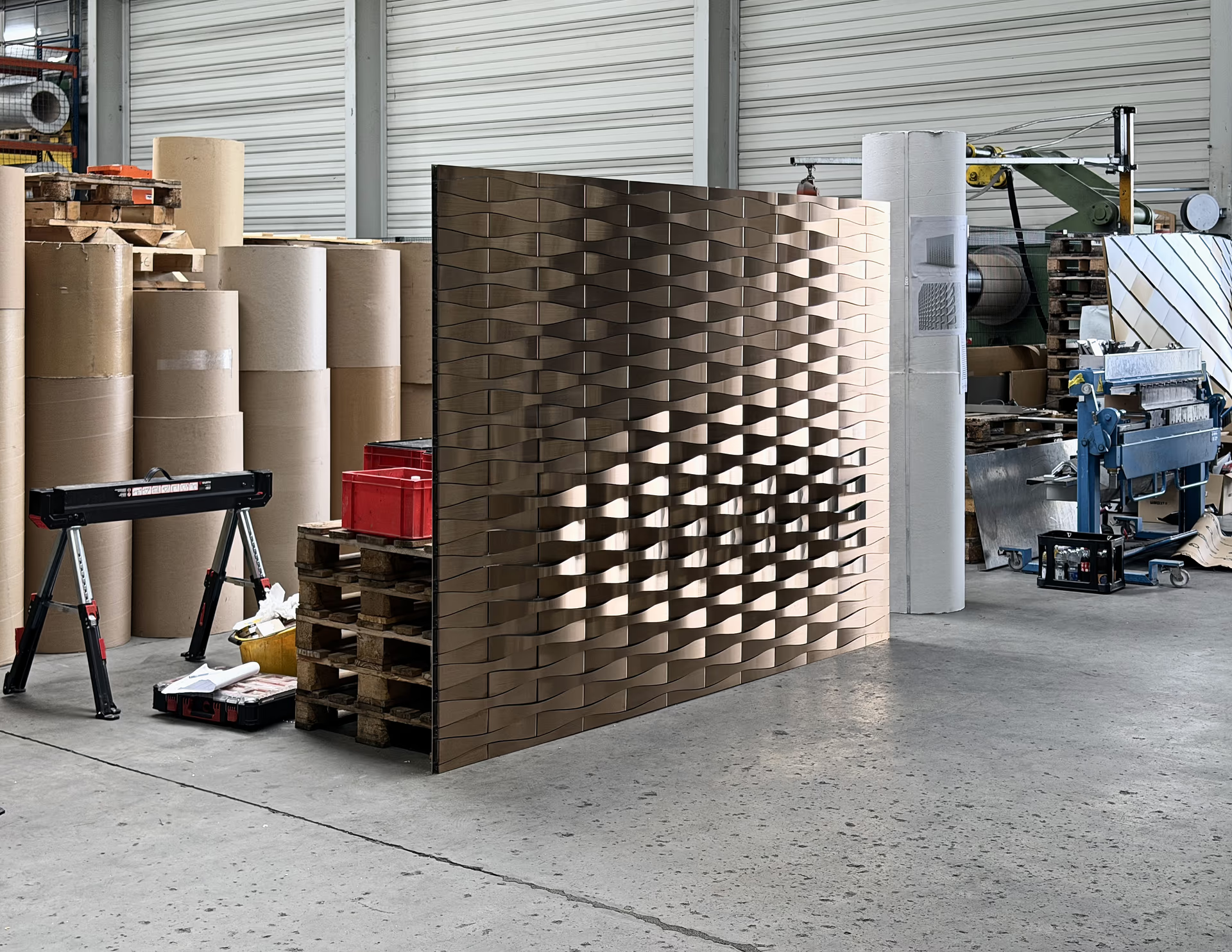
The facade is made of short metal strips in staggered rows. Each strip is slightly longer than the gap between its two holders, so it bows outwards. It also tapers towards the middle. Lens-shaped shadow joints open up between the strips and the surface reads as a weave.
A purpose-built algorithm turns the design into exact dimensions, checks that the material can take the bend, groups identical parts into types and outputs the cutting data for production.
Flat strips, sprung into a weave
Formed by Tension
The strips are cut flat and only sprung between the holders during assembly. The shape comes purely from the elasticity of the metal, with no bending. Over a half-metre span, just over a millimetre of extra length gives 1.5 centimetres of depth. Like bricks in a wall, the holders shift by half a pitch from row to row, so bows and joints interlock.
Behind the Facade
In the design, lines are laid across the facade. Strips close to a line bow strongly, those further away less so. Each holder is tilted to follow the bend angle at the strip end, so the metal never kinks. Every strip and holder carries a laser-etched number giving its position and connection. Assembly follows the numbers, with no measuring.
In Production
The fibre laser cuts each strip with its tapered outline and number, without special tooling. Even small dimensional errors would change the bow. The holders are bent on a CNC press brake, each at its calculated angle. The material is Rimex T22 Prestige Rosy Gold with a hairline finish, 1.5 mm thick.
476 Parts, 56 Types
- 01
221 strips in 22 types, by bow. Length 233 to 498 mm, height at the holder 81 mm.
- 02
255 holders in 34 types, by angle. 500 mm pitch, 250 mm offset per row.
- 03
Facade section 2968 × 2000 mm, 5.94 m².
Project data
- Year
2026
- Scope
Design logic, bend check, part typing, and cutting, substructure and assembly data for a 2968 × 2000 mm facade section.
- Partners
Gebr. Adelsberger GmbH Production
- Technologies
Parametric Design, Laser Cutting, CNC Bending